
Skip to content

Federal Court Rejects Personal Jurisdiction Over Foreign Adult Website Despite CDN Use, Cookies, Geolocation, and Advertising Revenue

In a significant decision addressing personal jurisdiction in the digital age, the United States District Court for the District of Kansas dismissed claims against a Spanish-operated adult-content website, holding that the website’s use of content delivery networks (CDNs), cookies, geolocation technology, and advertising revenue did not establish sufficient contacts with Kansas to satisfy constitutional due process requirements. The Case In Q.R., a minor, by and through Jane Doe v. Pump Lab, SL, Case No. 6:25-cv-01095 (D. Kan. June 22, 2026), a Kansas plaintiff alleged that a foreign pornography website violated Kansas’s age-verification statute by allowing a minor to access adult…

Read more
Photo of Congress building in Washington DC under blue sky.

Federal Age-Verification Proposal for Adult Websites Gains Bipartisan Momentum

On June 22, 2026, House Energy and Commerce Committee Chairman Brett Guthrie and Ranking Member Frank Pallone announced a bipartisan agreement on the Kids Internet and Digital Safety Act, or KIDS Act. According to the committee announcement, the package includes portions of several children’s online safety bills, including the SCREEN Act. For the adult-entertainment industry, the SCREEN Act is the key issue. Prior versions of the SCREEN Act focused on requiring certain websites that make adult material available online to use age-verification technology to prevent minors from accessing material harmful to minors. The committee has not yet released the final…

Read more
Photo of the Australian Flag

Australia’s eSafety Commissioner Takes Action Against Another AI “Nudify” Service

Australia’s eSafety Commissioner has begun enforcement action against another major AI-powered “nudify” service for allegedly failing to protect Australian children from exposure to sexually explicit deepfake content. According to eSafety, the service allows users to upload images of real people and generate sexually explicit deepfake content on demand. eSafety issued a formal Direction to Comply to the service, giving it 14 days to implement stronger protections to prevent children from accessing the service. The action is significant because it shows that Australia’s online safety regulator is moving quickly against AI services that create or facilitate sexualized deepfake content, particularly where…

Read more
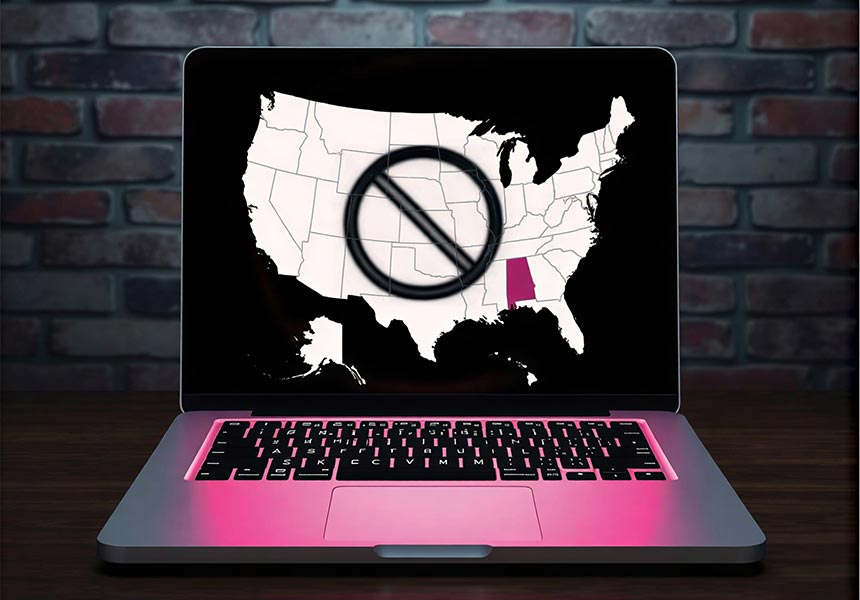
Photo of a laptop with United States map on screen

Not so Sweet Alabama – How the State Became One of the Most Hostile Jurisdictions for the Adult Industry

Over the past two years, Alabama has quietly — but aggressively — transformed itself into one of the most restrictive and unfriendly jurisdictions in the United States for the adult entertainment industry. Through the enactment of House Bill 164 and related enforcement mechanisms, the state has layered taxation, compliance burdens, and content restrictions in a way that goes far beyond traditional regulation. Featured In The May 2026 Edition Of XBIZ World Taken together, these measures — most notably a 10% tax on adult-content revenue, mandatory age verification requirements, and a notarization mandate for performer consent documents — have created a…

Read more
Legal Impact logo with black serif type with headshots and red color block and textured background

Attorney Corey D. Silverstein to host new Legal Impact Webinar on the new North Carolina Age Verification Law

Cyberspace (February 4, 2026) - Corey D. Silverstein, the driving force behind MyAdultAttorney.com and Adult.Law, is pleased to announce that he will be hosting his latest Legal Impact Webinar entitled "North Carolina AV Law - Content Creation Issues" on February 26th at 4:00 PM EST. This session, sponsored by Pig Machine, with exclusive media sponsor XBIZ, will be moderated by ClaraKitty and feature special guests Siouxsie Q and attorney Lawrence Walters. The North Carolina law has created major confusion for the adult community, its access to adult websites, and their ability to create, upload and view adult content. This webinar…

Read more
Illustration of a man signing a contract

How to Bulletproof Your Creator Management Contracts Heading into 2026

The creator management business is booming. Every week, a new agency emerges promising to turn creators into stars, automate their fan interactions, or triple their revenue through “secret” social strategies. The reality? Many of these agencies are operating with contracts that wouldn’t survive a single serious dispute — if they even have contracts at all. As creator income grows, so does the legal risk. Revenue-sharing models, international collaborations, and the explosion of AI tools have pushed creator management far beyond simple social media marketing. Yet too many agencies are relying on outdated influencer templates or vague promises that collapse the…

Read more
Photo of a woman looking at a phone with white map of Florida in upper right corner

Florida’s AG Launches Aggressive Age Verification Enforcement, Targeting Tube Sites and Channel Partners

Urgent Compliance The landscape for the adult entertainment industry operating in Florida has changed from one of legal uncertainty to one of immediate, high-stakes compliance. Following the enactment of the state’s age verification law (HB 3) on January 1, 2025, Florida Attorney General James Uthmeier has launched an aggressive enforcement campaign, filing multiple complaints against major online platforms and their affiliates for openly defying the law. The clear message from the Attorney General’s office is that the time for passive observation is over. Any commercial entity that publishes or distributes material “harmful to minors” — defined as a “substantial portion”…

Read more
Illustration of a man holding a giant magnifying lgass over a laptop

North Carolina Hits the Industry Hard with HB 805

North Carolina House Bill 805 An act originally aimed at combating sexual exploitation in the adult entertainment industry has become a wide-ranging law in North Carolina, with significant implications for performers, platforms, and public policy on a number of unrelated issues. North Carolina House Bill 805, which was recently enacted by the state legislature, was initially a bipartisan effort to purportedly protect individuals from having nonconsensual sexually explicit content distributed online. However, as the bill progressed through the legislative process, it was amended to include a host of other provisions, particularly those related to transgender rights and parental oversight in…

Read more
Back To Top
Search