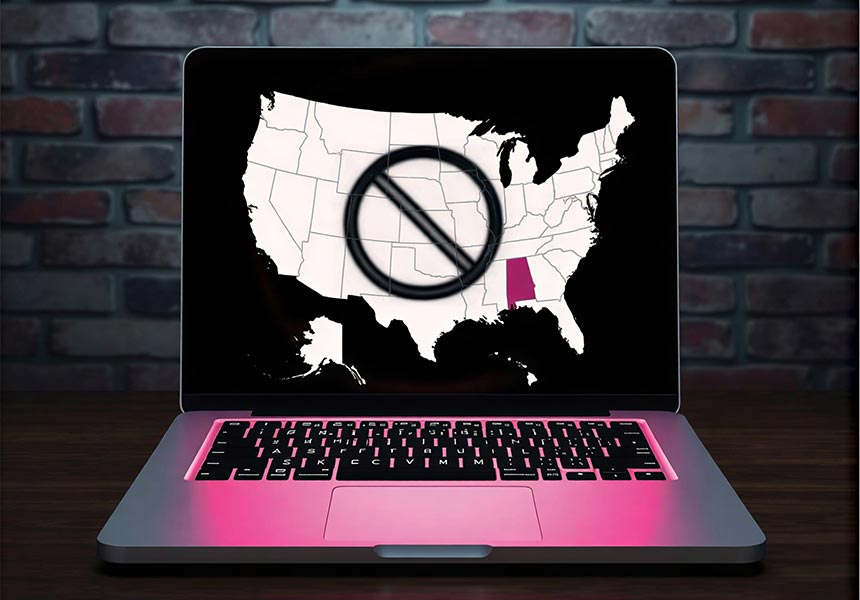
Over the past two years, Alabama has quietly — but aggressively — transformed itself into one of the most restrictive and unfriendly jurisdictions in the United States for the adult entertainment industry. Through the enactment of House Bill 164 and related enforcement mechanisms, the state has layered taxation, compliance burdens, and content restrictions in a way that goes far beyond traditional regulation.
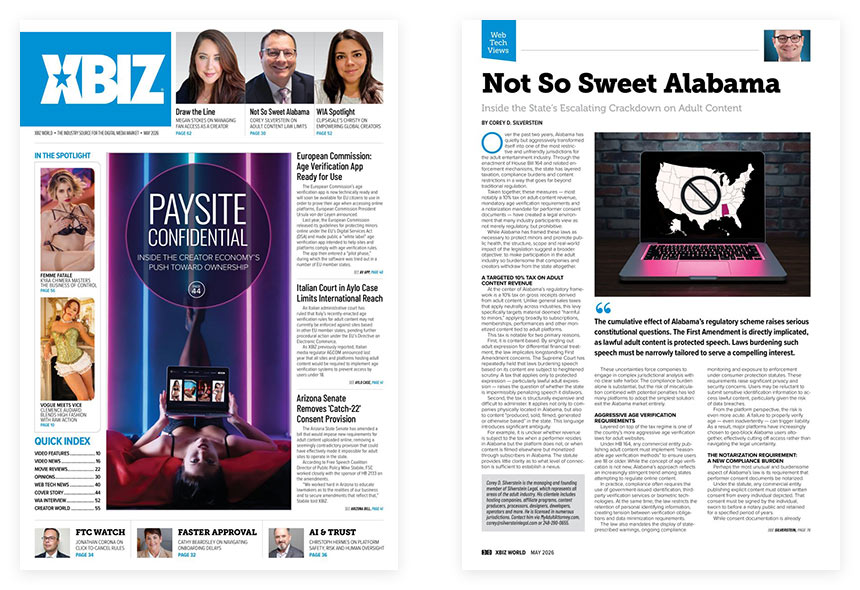
Featured In The May 2026 Edition Of XBIZ World
Taken together, these measures — most notably a 10% tax on adult-content revenue, mandatory age verification requirements, and a notarization mandate for performer consent documents — have created a legal environment that many industry participants view as not merely regulatory, but prohibitive.
While Alabama has framed these laws as necessary to protect minors and promote public health, the structure, scope, and real-world impact of the legislation suggest a broader objective: to make participation in the adult industry so burdensome that companies and creators simply withdraw from the state altogether.
A Targeted 10% Tax on Adult Content Revenue
At the center of Alabama’s regulatory framework is a 10% tax on gross receipts derived from adult content. Unlike general sales taxes that apply neutrally across industries, this levy specifically targets material deemed “harmful to minors,” applying broadly to subscriptions, memberships, performances, and other monetized content tied to adult platforms.
This tax is notable for two primary reasons.
First, it is content-based. By singling out adult expression for differential financial treatment, the law implicates longstanding First Amendment concerns. The Supreme Court has repeatedly held that laws burdening speech based on its content are subject to heightened scrutiny. A tax that applies only to protected expression — particularly lawful adult expression — raises the question of whether the state is impermissibly penalizing speech it disfavors.
Second, the tax is structurally expansive and difficult to administer. It applies not only to companies physically located in Alabama, but also to content “produced, sold, filmed, generated, or otherwise based in” the state. This language introduces significant ambiguity.
For example, it is unclear whether revenue is captured when a performer resides in Alabama, but the platform does not, or when content is filmed elsewhere but monetized through Alabama subscribers. The statute provides little clarity as to what level of connection is sufficient to establish nexus.
These uncertainties force companies to engage in complex jurisdictional analysis with no clear safe harbor. The compliance burden alone is substantial, but the risk of miscalculation — combined with potential penalties — has led many platforms to adopt the simplest solution: exit the Alabama market entirely.
Aggressive Age Verification Requirements
Layered on top of the tax regime is one of the country’s more aggressive age verification laws for adult websites.
Under HB 164, any commercial entity publishing adult content must implement “reasonable age verification methods” to ensure users are 18 or older. While the concept of age verification is not new, Alabama’s approach reflects an increasingly stringent trend among states attempting to regulate online content.
In practice, compliance often requires the use of government-issued identification, third-party verification services, or biometric technologies. At the same time, the law restricts the retention of personal identifying information, creating tension between verification obligations and data minimization requirements.
The law also mandates the display of state-prescribed warnings, ongoing compliance monitoring, and exposure to enforcement under consumer protection statutes. These requirements raise significant privacy and security concerns. Users may be reluctant to submit sensitive identification information to access lawful content, particularly given the risk of data breaches.
From the platform perspective, the risk is even more acute. A failure to properly verify age — even inadvertently — can trigger liability. As a result, major platforms have increasingly chosen to geo-block Alabama users altogether, effectively cutting off access rather than navigating the legal uncertainty.
The Notarization Requirement: A New Compliance Burden
Perhaps the most unusual — and burdensome — aspect of Alabama’s law is its requirement that performer consent documents be notarized.
Under the statute, any commercial entity publishing explicit content must obtain written consent from every individual depicted. That consent must be signed by the individual, sworn to before a notary public, and retained for a specified period of years.
While consent documentation is already required, Alabama’s notarization requirement goes significantly further. This additional step introduces practical challenges, particularly for remote or on-demand content creation. Independent creators may struggle to obtain notarization efficiently, and international performers face additional barriers.
For platforms, the burden lies in ensuring compliance across large volumes of content. The requirement transforms what is typically an administrative process into a formalized legal procedure, increasing both cost and friction. As a result, it functions as a significant barrier to entry and continued operation.
Public Statements Underscore Legislative Intent
Any lingering doubt about Alabama’s true objective — whether it is genuinely focused on protecting minors or instead aimed at suppressing lawful adult content — has been further eroded by public statements from lawmakers themselves.
Following the implementation of Alabama’s regulatory scheme, major adult platforms, including Pornhub, elected to block access to users within the state rather than attempt compliance. Alabama State Representative Ben Robbins has publicly celebrated this outcome.
Rather than expressing concern that adults are being cut off from lawful content, Rep. Robbins has pointed to the shutdown as a success. This reaction is telling. If the primary purpose of the law were truly to protect minors, policymakers would be expected to focus on refining compliance mechanisms that allow lawful access while safeguarding children.
Instead, the public celebration of platform withdrawal suggests a different legislative objective: to drive adult content providers out of the state entirely. Courts evaluating First Amendment challenges routinely examine legislative intent and practical effect. When lawmakers endorse the elimination of protected speech, it strengthens the argument that the law is not narrowly tailored but instead operates as a de facto ban.
Constitutional Tensions and Legal Vulnerability
The cumulative effect of Alabama’s regulatory scheme raises serious constitutional questions.
The First Amendment is directly implicated, as lawful adult content is protected speech. Laws burdening such speech must be narrowly tailored to serve a compelling interest. While protecting minors is a legitimate goal, the means chosen must not unnecessarily restrict adult access.
The combined requirements may also be challenged as overbroad. If the practical effect is to eliminate access for adults, the statute risks failing constitutional scrutiny.
There are also potential Dormant Commerce Clause concerns, as Alabama’s law imposes obligations on platforms operating across state lines. Additionally, the privacy implications of age verification regimes may invite further scrutiny, particularly where identity disclosure chills access to protected expression.
The Cumulative Effect: Regulation or Suppression
Individually, each provision could be framed as a consumer protection measure. However, together they create a regulatory framework that is uniquely burdensome.
By increasing compliance costs, legal risk, and operational complexity, Alabama effectively encourages companies to exit the market. This outcome is already visible, with platforms blocking access and creators reconsidering their presence in the state.
Conclusion
Alabama’s recent legislative actions mark a significant shift in how states regulate the adult industry. Through a combination of targeted taxation, aggressive verification mandates, and unprecedented consent requirements, the state has positioned itself as one of the most restrictive jurisdictions in the country.
Whether these laws withstand constitutional scrutiny remains an open question. But their immediate impact is clear: Alabama has created a legal environment in which participation in the adult industry is increasingly untenable.
At minimum, the state has demonstrated how layered regulatory mechanisms can combine to produce a system that effectively suppresses lawful speech. Whether courts ultimately view this as permissible regulation or unconstitutional overreach will determine not only the future of Alabama’s law, but potentially the trajectory of similar efforts nationwide.
This article does not constitute legal advice and is provided for your information only and should not be relied upon in lieu of consultation with legal advisors in your own jurisdiction. It may not be current as the laws in this area change frequently. Transmission of the information contained in this article is not intended to create, and the receipt does not constitute, an attorney-client relationship between sender and receiver.
About Silverstein Legal
Founded in 2006 by adult entertainment lawyer Corey D. Silverstein, Silverstein Legal is a boutique law firm that caters to the needs of anyone working in the adult entertainment industry. Silverstein Legal’s clients include hosting companies, affiliate programs, content producers, processors, designers, developers, and website operators.
Related Articles