In the crowded field of Florida’s 2026 gubernatorial race, Republican candidate James Fishback has managed…

In December 2025, the Office of the Comptroller of the Currency (OCC) released preliminary findings from a supervisory review of “debanking” at the nine largest national banks it oversees. The OCC’s headline conclusion was blunt: across 2020–2023, these banks maintained policies that made “inappropriate distinctions” among customers based on lawful business activity — often through blanket sector restrictions or heightened internal barriers that functioned like denials of service.
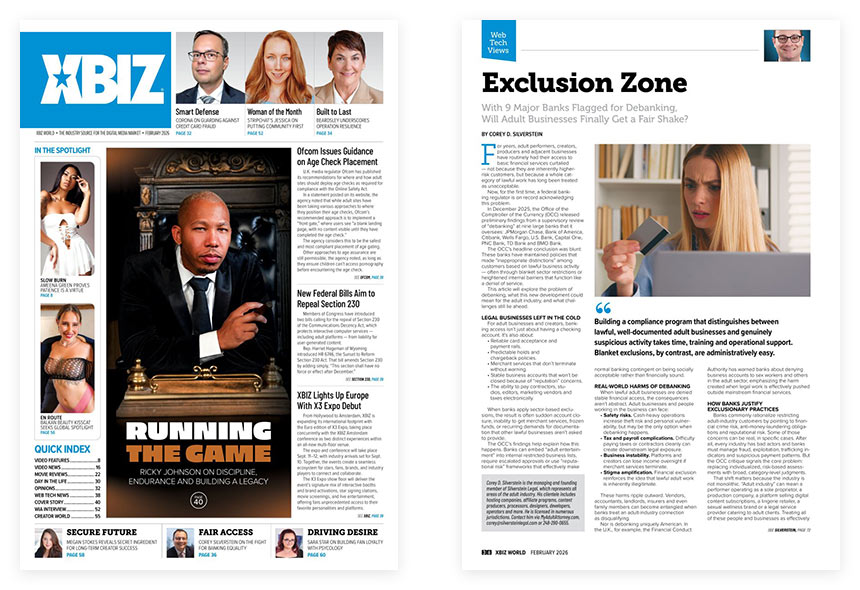
Featured In The February 2026 Edition Of XBIZ World
For the adult industry, the report mattered for a simple reason: it put a federal banking regulator on record acknowledging what performers, creators, producers, and adjacent lawful businesses have said for years — access to basic financial services is routinely curtailed not because a customer is inherently higher-risk, but because a category of lawful work is treated as presumptively unacceptable.
What the OCC said about adult entertainment restrictions
The OCC’s preliminary findings document identifies “adult entertainment” as one of the industry sectors impacted by bank policies. It describes internal practices where lines of business at some banks either strictly restricted access to certain products/services or required escalated review for customers connected to “adult media and non-media” (including “products and services of a sexual nature”).
Importantly, the OCC did not frame this as a set of isolated mistakes or one-off customer service failures. The critique focused on policy-level choices — statements and rules that can be applied broadly, regardless of an individual customer’s actual risk profile. Reuters summarized the report as finding that the nine largest banks had enacted policies limiting or denying services to certain “controversial” industries during that period, including adult entertainment.
The nine banks in the OCC’s review were: JPMorgan Chase, Bank of America, Citibank, Wells Fargo, U.S. Bank, Capital One, PNC Bank, TD Bank, and BMO Bank.
Why “lawful” doesn’t guarantee “bankable”
To people outside the industry, banking discrimination can sound like an exaggeration — until you map what “access to banking” actually means for modern work.
For adult businesses and creators, banking access isn’t just about having a checking account. It’s also about:
- reliable card acceptance and payment rails
- predictable holds and chargeback policies
- merchant services that don’t terminate without warning
- stable business accounts that won’t be closed because of “reputation” concerns
- the ability to pay contractors, studios, editors, marketing vendors, and taxes electronically
When banks apply sector-based exclusions, the result is often sudden account closure, inability to get merchant services, frozen funds, or recurring demands for documentation that other lawful businesses aren’t asked to provide.
The OCC’s findings help explain how this happens: banks can embed “adult entertainment” into internal restricted-business lists, require escalated approvals, or use reputational-risk frameworks that effectively make normal banking contingent on being “socially acceptable,” rather than financially sound.
The compliance reality banks cite — and where it goes off the rails
Banks commonly justify restricting adult-industry customers by pointing to financial crime risk, anti–money laundering obligations, and reputational risk. Some of those concerns can be real in specific cases — every industry has bad actors, and banks must manage fraud, exploitation, trafficking indicators, and suspicious payment patterns. But the OCC critique signals the core problem: replacing individualized, risk-based assessments with broad, category-level judgments.
That shift matters because adult entertainment is not a single monolith. “Adult industry” can mean a performer operating as a sole proprietor, a lawful production company, a platform selling digital content subscriptions, a lingerie retailer, a sexual wellness brand, or a legal service provider to adult clients. Treating all of it as effectively unbankable is not risk management — it’s risk avoidance at the expense of lawful commerce.
And it is not uniquely American. In the UK, for example, the Financial Conduct Authority warned banks about denying business accounts to sex workers and others in the adult sector, emphasizing the harm created when legal work is effectively pushed outside mainstream financial services.
Why the problem persists even after public scrutiny
If a regulator is openly criticizing “inappropriate distinctions,” why does banking discrimination in adult industries keep happening?
- “Reputational risk” is elastic. Banks can’t easily quantify it, and it often becomes a catch-all justification. Once an industry category is deemed reputation-sensitive, the safest internal move is to deny or offboard rather than develop nuanced controls.
- De-risking is operationally convenient. Building a compliance program that distinguishes between lawful, well-documented adult businesses and genuinely suspicious activity takes time, training, and operational support. Blanket exclusions are administratively easy.
- Payments are a chokepoint. Even when a bank is willing to keep a deposit account open, payment processing partners, card networks, or third-party vendor policies can still cause disruptions. This creates an ecosystem where a single risk-averse node can collapse the whole chain.
- Adult creators are disproportionately “small business.” Many creators are independent contractors or micro-businesses without dedicated compliance teams or sophisticated accounting support. That makes them more vulnerable to documentation demands, inconsistent underwriting, and sudden policy changes.
The real-world harms of adult-industry debanking
When lawful adult businesses are denied stable financial access, the consequences aren’t abstract:
- Safety risks: cash-heavy operations increase theft risk and personal vulnerability.
- Tax and payroll complications: difficulty paying taxes or contractors cleanly can create downstream legal exposure.
- Business instability: platform creators can lose income overnight if merchant services terminate.
- Stigma amplification: financial exclusion reinforces the idea that lawful adult work is inherently illegitimate.
These harms ripple outward. Vendors, accountants, landlords, insurers, and even family members can become entangled when banks treat an adult-industry connection as disqualifying.
What “fair access” could look like in practice
The OCC’s report was preliminary, but it points toward a framework regulators and banks could adopt: risk-based, conduct-specific decisions rather than category-based exclusions.
A workable fair-access approach would include:
- Clear written standards distinguishing legal adult businesses from prohibited or illegal conduct
- Consistent onboarding requirements (so adult businesses aren’t subjected to arbitrary hurdles)
- Appeal and review processes before account closures or service terminations
- Narrowly tailored controls (e.g., transaction monitoring calibrated to actual typologies)
- Documented reasons for adverse action that go beyond “reputation”
In other words: treat adult businesses like other lawful, risk-manageable industries — because they are.
Bottom Line
The OCC’s December 2025 preliminary findings did not merely validate individual complaints; they documented a systemic pattern: nine of the largest national banks maintained policies that restricted or effectively denied services to categories of lawful customers, including adult entertainment.
That acknowledgment is significant — but it doesn’t solve the problem by itself. Banking discrimination against the adult industry persists because stigma, reputational-risk logic, and operational incentives still make “debanking” feel safer to institutions than building nuanced compliance pathways.
If regulators want lawful commerce to remain lawful in practice, not just in theory, fair access has to mean more than discouraging political or cultural bias. It has to mean that banks can’t quietly convert “lawful but unpopular” into “functionally unbankable” — especially when the costs are borne by small businesses, independent workers, and the broader economy that depends on stable financial participation.
This article does not constitute legal advice and is provided for your information only and should not be relied upon in lieu of consultation with legal advisors in your own jurisdiction. It may not be current as the laws in this area change frequently. Transmission of the information contained in this article is not intended to create, and the receipt does not constitute, an attorney-client relationship between sender and receiver.
About Silverstein Legal
Founded in 2006 by adult entertainment lawyer Corey D. Silverstein, Silverstein Legal is a boutique law firm that caters to the needs of anyone working in the adult entertainment industry. Silverstein Legal’s clients include hosting companies, affiliate programs, content producers, processors, designers, developers, and website operators.
Related Articles