WASHINGTON — The U.S. Supreme Court ruled unanimously last week against music industry record labels…

In the crowded field of Florida’s 2026 gubernatorial race, Republican candidate James Fishback has managed to generate national headlines with a proposal that blends culture-war rhetoric with fiscal policy: a 50 percent “sin tax” on income earned by Florida-based OnlyFans creators.
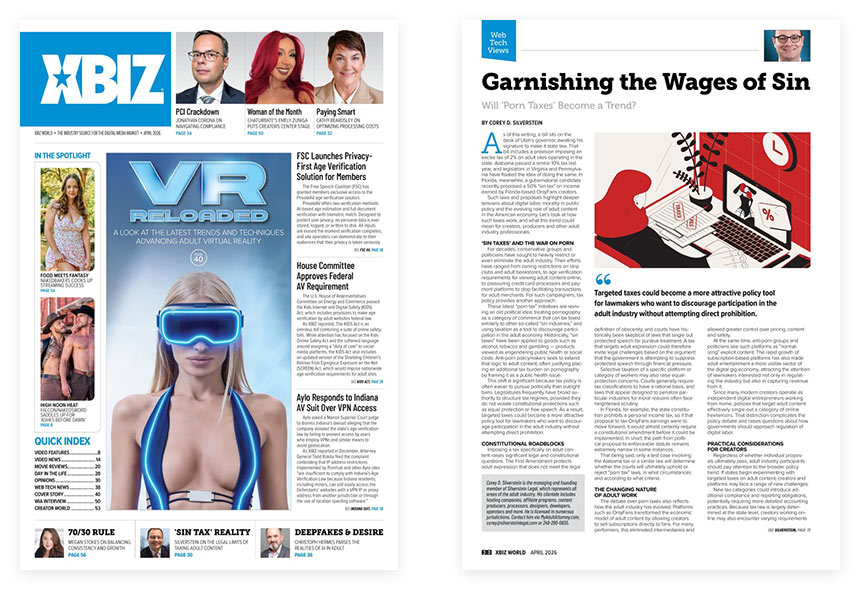
Featured In The April 2026 Edition Of XBIZ World
Don’t Worry: This Law Is Going Nowhere
The idea, which Fishback frames as both a moral corrective and a revenue-raising tool, has drawn sharp reactions from across the political spectrum. Supporters characterize it as a bold stand against what they view as the social harms of online adult content. Critics argue it represents the latest chapter in a long pattern of conservative political efforts aimed at restricting or stigmatizing the adult entertainment industry.
Whether seen as principled or punitive, the proposal is almost certain to face insurmountable legal and constitutional barriers. But beyond its legislative viability, the debate surrounding it highlights deeper tensions about digital labor, morality in public policy, and the evolving role of adult content in the American economy.
Who Is James Fishback?
James Thomas Fishback is a Florida-born hedge fund manager and the founder and CEO of Azoria Partners. Born in 1995, he has positioned himself as a young, outspoken conservative voice aligned with the Republican Party’s populist wing.
In 2026, Fishback entered the race for the Republican nomination for governor of Florida. His campaign platform includes abolishing property taxes, restricting certain visa programs, opposing construction of large-scale AI data centers in the state, and advancing socially conservative policies. The proposed OnlyFans tax has become one of his most widely discussed — and controversial — policy ideas.
Fishback has described OnlyFans as emblematic of moral decline and has argued that Florida should not allow what he considers “online degeneracy” to flourish without consequence. His proposed 50 percent tax would apply specifically to income earned by Florida residents producing content on the subscription-based platform, which is widely known for adult content but also hosts fitness trainers, musicians, chefs, and other creators.
The Proposal: A 50 Percent “Sin Tax”
Fishback’s proposal would impose a 50 percent levy on income earned by Florida-based OnlyFans creators. He has suggested that the revenue could be used to fund teacher pay raises, school meal programs, crisis pregnancy centers, and a new “mental health czar” focused on men’s issues.
Historically, “sin taxes” have been applied to goods such as alcohol, tobacco, and gambling — products that lawmakers argue impose public health or social costs. Fishback’s framing attempts to extend that logic to digital adult content, positioning the platform’s creators as contributors to broader societal harm.
However, the proposal diverges from traditional sin taxes in a key respect: rather than taxing a product or transaction, it would tax the income of a specific class of workers based on the nature of their work.
That distinction has significant legal implications.
Constitutional Roadblocks
The most immediate barrier is Florida’s constitution, which prohibits the state from levying a personal income tax. Florida is one of a handful of states with no state income tax — a policy often touted as central to its pro-business identity.
A targeted 50 percent tax on OnlyFans earnings would function, in effect, as a selective income tax. Implementing it would almost certainly require a constitutional amendment, which would need legislative approval and voter ratification.
Even if that hurdle were cleared, additional legal challenges would likely follow. Singling out income earned from a specific platform could invite equal protection claims under both state and federal law. Courts generally require tax classifications to have a rational basis, and a law targeting one digital platform’s creators while leaving similar online earners untouched would face intense scrutiny.
In short, as a matter of practical governance, the path from campaign promise to enforceable statute appears extremely narrow.
A Broader Conservative Campaign Against the Adult Industry
Fishback’s proposal does not exist in isolation. For decades, segments of the conservative movement have sought to regulate, restrict, or eliminate portions of the adult entertainment industry.
Efforts have ranged from zoning restrictions on strip clubs and adult bookstores, to age-verification requirements for online pornography, to campaigns aimed at credit card processors and payment platforms that facilitate adult content transactions. In recent years, several Republican-led states have enacted laws requiring stricter age verification for adult websites, citing concerns about minors’ access.
Advocates of such measures argue they are motivated by public health, exploitation concerns, and the protection of children. Opponents contend that many of these policies function less as targeted safeguards and more as broad attempts to suppress a legal industry rooted in First Amendment protections.
In that context, a punitive tax directed at OnlyFans creators can be interpreted as part of a larger ideological project: using state power — whether through regulation, taxation, or liability — to discourage participation in the adult economy.
The Changing Nature of Adult Work
The debate also reflects how the adult industry itself has changed.
OnlyFans, founded in 2016, transformed the economic model of adult content by allowing creators to sell subscriptions directly to fans. For many performers, this eliminated intermediaries and allowed greater control over pricing, content, and safety. Some creators describe the platform as empowering, offering financial independence and flexibility unavailable in traditional employment.
At the same time, critics argue that the platform contributes to normalization of explicit content and raises concerns about exploitation and long-term social effects.
The shift from centralized studios to decentralized, subscription-based digital work complicates the political conversation. Unlike brick-and-mortar adult businesses, OnlyFans creators often work from home, function as independent contractors, and operate much like other digital entrepreneurs.
A tax targeting them would effectively single out a category of online freelancers — a move that could have ripple effects beyond the adult industry itself.
Political Calculus in a Primary Election
As a candidate in a Republican primary, Fishback’s proposal may serve a political purpose beyond its policy feasibility. Culture-war issues have become a defining feature of primary contests, particularly in states like Florida where social conservatism remains influential.
Taking a strong stance against adult content aligns with certain segments of the Republican base. Even if the proposal never advances legislatively, it signals ideological clarity to voters who prioritize moral and cultural issues.
However, statewide general elections often demand broader appeal. Florida’s economy includes tourism, entertainment, and a large gig-economy workforce. Policies perceived as punitive toward specific professions could alienate libertarian-leaning Republicans and independent voters who favor limited government intervention.
Freedom, Morality, and the Limits of Tax Policy
At its core, the “OnlyFans sin tax” debate raises an enduring question in American politics: To what extent should the government use taxation to enforce moral judgments?
Sin taxes have long existed, but they traditionally target goods rather than workers. Moving from taxing products to taxing professions based on moral disapproval marks a significant shift.
Critics argue that such a precedent could open the door to selective taxation of other disfavored industries. Supporters counter that states have always used fiscal tools to influence behavior.
For now, despite the headlines, there is little reason for creators or observers to fear imminent change. Constitutional barriers, legal scrutiny, and political realities make its passage improbable. The proposal may energize a primary campaign, but as actual law, it appears headed nowhere.
This article does not constitute legal advice and is provided for your information only and should not be relied upon in lieu of consultation with legal advisors in your own jurisdiction. It may not be current as the laws in this area change frequently. Transmission of the information contained in this article is not intended to create, and the receipt does not constitute, an attorney-client relationship between sender and receiver.
About Silverstein Legal
Founded in 2006 by adult entertainment lawyer Corey D. Silverstein, Silverstein Legal is a boutique law firm that caters to the needs of anyone working in the adult entertainment industry. Silverstein Legal’s clients include hosting companies, affiliate programs, content producers, processors, designers, developers, and website operators.
Related Articles