Skip to content
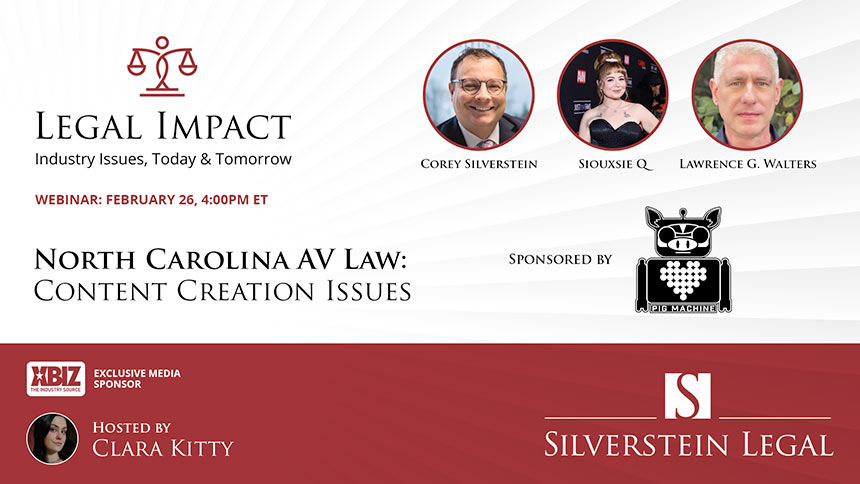
Legal Impact logo with black and serif type with headshots and red color block and textured background

Attorney Corey D. Silverstein to host new Legal Impact Webinar on the new North Carolina Age Verification Law

Cyberspace (February 4, 2026) - Corey D. Silverstein, the driving force behind MyAdultAttorney.com and Adult.Law, is pleased to announce that he will be hosting his latest Legal Impact Webinar entitled "North Carolina AV Law - Content Creation Issues" on February 26th at 4:00 PM EST. This session, sponsored by Pig Machine, with exclusive media sponsor XBIZ, will be moderated by ClaraKitty and feature special guests Siouxsie Q and attorney Lawrence Walters. The North Carolina law has created major confusion for the adult community, its access to adult websites, and their ability to create, upload and view adult content. This webinar has been put together to help the adult community understand the impact of this law and help you figure out your next steps as a creator, performer, or platform. “”Havoc” is the best word that I can use to describe what North Carolina’s law has caused the adult entertainment industry.” said Corey D. Silverstein. “The topic of this webinar was chosen because of the substantial community outreach that I received following numerous platforms and content creators abandoning all activities with North Carolina.” Silverstein continued. “The revocation of consent component of North Carolina’s law has been especially destructive for the industry.”…

Read more
Photo of a woman trying to use a credit card

Nine Large Banks Flagged for “Debanking” Policies That Hit Adult Businesses — and Why the Problem Isn’t Going Away

In December 2025, the Office of the Comptroller of the Currency (OCC) released preliminary findings from a supervisory review of “debanking” at the nine largest national banks it oversees. The OCC’s headline conclusion was blunt: across 2020–2023, these banks maintained policies that made “inappropriate distinctions” among customers based on lawful business activity — often through blanket sector restrictions or heightened internal barriers that functioned like denials of service. Featured In The February 2026 Edition Of XBIZ World For the adult industry, the report mattered for a simple reason: it put a federal banking regulator on record acknowledging what performers, creators, producers, and adjacent lawful businesses have said for years — access to basic financial services is routinely curtailed not because a customer is inherently higher-risk, but because a category of lawful work is treated as presumptively unacceptable. What the OCC said about adult entertainment restrictions The OCC’s preliminary findings document identifies “adult entertainment” as one of the industry sectors impacted by bank policies. It describes internal practices where lines of business at some banks either strictly restricted access to certain products/services or required escalated review for customers connected to “adult media and non-media” (including “products and services of a sexual…

Read more
Illustration of robot judge holding gavel and scales of justice

The Importance of Protecting AI Content Generation Rights for Content Producers

In today’s digital age, content producers have more tools at their disposal than ever before. Among these tools, artificial intelligence (AI) content generation has emerged as a game-changer, enabling creators to produce high-quality content quickly and efficiently. However, with this convenience comes a significant responsibility: safeguarding the rights associated with AI-generated content. Failing to do so can have long-term repercussions for creators and their intellectual property. Regardless of the type of content that you are creating, the game has changed and there quite a few legal considerations. Featured In The March 2025 Edition Of XBIZ World Understanding AI Content Generation Rights AI content generation rights refer to the ownership and usage rights of content produced with the assistance of AI tools. These rights often extend to include the following aspects: Ownership of Generated Content Determining who legally owns the output created by AI — the individual, organization, or AI tool provider. Licensing Agreements Many AI tools operate under specific licensing terms, which may grant the tool’s developer partial or full rights to the generated content. Derivative Works Understanding whether the content created with AI can be modified, reused, or resold without violating the terms of use. Warning! Why Content Producers…

Read more
Back To Top